
Lesson Plans
Writing Lesson: Discussion Board Post
This writing lesson plan focuses on analyzing and evaluating discussion board posts and composing a one-paragraph post. Activities include analyzing model posts, discussing patterns and improvements, and practicing writing responses to prompts. The lesson aims to help students adapt their language for different contexts and audiences, with both collaborative and independent writing exercises.


Global Community Unit
This unit focuses on the concept of global citizenship. In a multicultural classroom, students must build unity with one another. As they develop a sense of global citizenship, they will come to understand one another’s backgrounds with greater appreciation. Another reason this topic was chosen is because many students feel a lack of belonging when they move to a new country. They may not feel they fit in and may feel a loss of identity. This unit, especially Pico Iyer’s TED Talk, emphasizes that we are all among a greater community and that home can be a feeling rather than a construction.
Integrating listening, reading, and writing skills, the unit helps students connect content to their background knowledge, support ideas with facts, and cite and paraphrase sources correctly.
Grammar Lesson: Adjectives and Nouns
This lesson begins with a Presentation of vocabulary and concepts, including identifying adjectives in sentences and acting out sentences with attributive adjectives. Attention is drawn to the order of adjectives and nouns through guided activities and discussions. Students then Co-construct their understanding by comparing predicative and attributive adjectives and creating adjective-noun pairs. Finally, the lesson includes Extension activities like describing pictures and planning a party, allowing students to apply their knowledge in practical contexts.


Grammar Lesson: Count and Noncount Nouns
This lesson follows the PACE model, providing a structured and interactive approach to learning. It begins with a Presentation of vocabulary and concepts using real-life examples like a yogurt parfait recipe. Attention is drawn to the differences between count and noncount nouns through hands-on activities with food items. Students then Co-construct their understanding by identifying and using these nouns in various contexts, including writing their own recipes. Finally, the lesson includes an Extension activity where students apply their knowledge to their own kitchens, reinforcing the practical application of the grammar rules.
Grammar Lesson: Subjects and Objects
This lesson follows the PACE model to teach ESL learners about subjects and objects in simple sentences. After a quick review of verbs, students engage in interactive activities to inductively discover subject-verb-object (SVO) structure. They then apply their understanding through a sentence-building activity and a writing task based on a Thai commercial, where they describe actions using the target grammar. The lesson concludes with reflection, an exit ticket, and a "Light the World" homework assignment, in which students write about how they will help others during the Christmas season using a subject, verb, and object.


Grammar Lesson: Yes/No Questions
This lesson follows the PACE model to teach novice-mid ESL learners yes/no questions with the verb "to be" in the present simple. It includes a quick review of "to be," guided questioning, and interactive activities like the Headbanz Game and an Information Gap task. Students inductively discover grammar patterns, practice forming questions, and distinguish them from statements. The lesson concludes with reflection, an exit ticket, and a homework interview to reinforce learning..
BYU Citizenship Clinic Lesson: The US Constitution
This lesson was designed to fit in Week 2 in a 10-lesson sequence as part of the U.S. Citizenship Clinic curriculum, which I took part in developing for the BYU Office of Belonging. Students participate in an N-400 Section 5 mock form and a mini-interview practice. They also explore key civics concepts through a Constitution-writing hook activity, discussions on amendments and rights, and reading and writing exercises with citizenship-related vocabulary. The lesson concludes with an exit ticket or Kahoot quiz to assess understanding and reinforce key concepts.

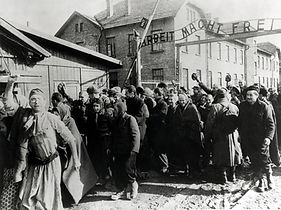
Listening Lesson: Liberation of Auschwitz
This lesson is focused on building students' abilities to listen for details and connect content to their background knowledge. In this lesson, students complete pre-listening activities designed to activate their prior knowledge and prepare students for both top-down and bottom-up listening. Then, they listen to a news broadcast while completing a scanning activity followed by a dictation activity. Finally, as a post-listening activity, students role-play as participants in the news broadcast themselves, which allows them to apply their knowledge.
Vocabulary-Focused Lesson: A Research on Happiness
This vocabulary-focused lesson involves pre-teaching key academic vocabulary, watching and summarizing a TED Talk by Robert Waldinger, and completing a collocations worksheet. The lesson includes interactive activities like think-pair-share, partner summaries, and fluency line summaries to reinforce vocabulary usage. The goal is for students to recognize, understand, and use high-frequency academic vocabulary in context.


Reading Lesson: Malcolm X
This reading lesson plan spans three days. It uses the "Question the Author" technique to focus on building background knowledge, understanding the main ideas, and analyzing the author's purpose and point of view. The lesson effectively integrates multimedia resources and interactive activities to enhance comprehension and critical thinking skills.